
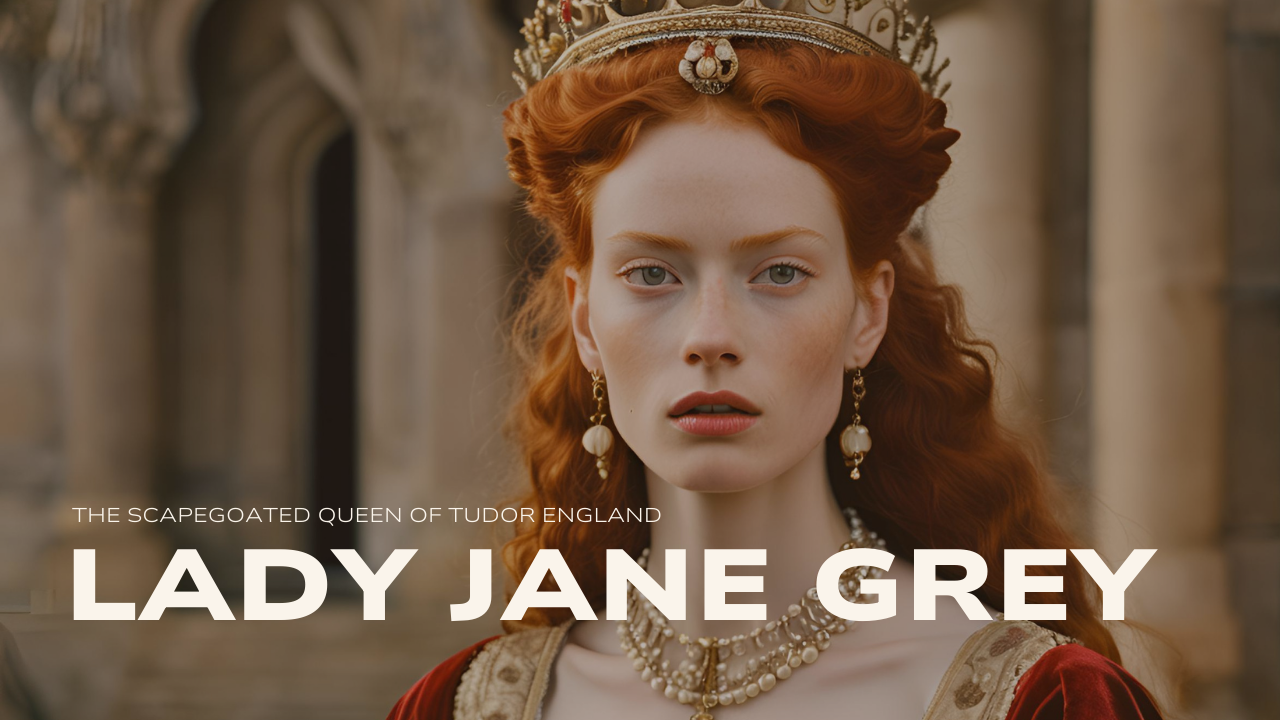
Lady Jane Grey, a great-granddaughter of Henry VII, is known as the “Nine-Day Queen.” She remains one of history’s most tragic figures. Her brief and reluctant reign in 1553 is a story of profound scapegoating. Here, an innocent young woman is punished to protect more powerful men. Jane’s story illustrates how women in patriarchal societies are sacrificed when the tides of power shift.
The Political Context
To understand why Lady Jane Grey became a scapegoat, we should consider the turbulent political landscape of Tudor England. The young King Edward VI, a staunch Protestant, was on his deathbed without a male heir. His half-sisters, Mary and Elizabeth, were next in line, but Edward, fearing the Catholic Mary would reverse the Reformation, sought to change the succession. John Dudley, Duke of Northumberland and Edward’s chief advisor, used this opportunity to consolidate his own power.
Northumberland arranged for Lady Jane Grey to marry his son, Lord Guildford Dudley. He then persuaded the dying king to name Jane as his successor. However, Jane herself was horrified upon being told she would be queen, and showed none of the ambition typically associated with usurpers.
The Fall of the Nine-Day Queen
When Edward VI died on 6 July 1553, Lady Jane Grey was proclaimed queen. However, the English people largely supported Mary Tudor, Henry VIII’s eldest daughter and the legitimate heir. Mary quickly rallied support, marching towards London with a growing army. Faced with overwhelming opposition, the Privy Council, which had initially backed Jane, switched allegiance to Mary. Jane’s reign lasted only nine days before she was deposed and imprisoned in the Tower of London.
Once Mary took the throne, Jane became a convenient scapegoat. Northumberland was executed swiftly, but Mary recognised Jane’s innocence and wanted to spare her. However, a subsequent Protestant rebellion, Wyatt’s Rebellion, aimed at removing Mary and restoring Jane to the throne, changed everything. Though Jane had no involvement in the uprising, Mary sought to solidify her rule and send a clear message to her opponents. This was why she ordered Jane’s execution.
Scapegoating and the Burden of Blame
Scapegoating involves assigning blame to an individual to protect more powerful individuals. In Lady Jane Grey’s case, the blame for the succession crisis and the Protestant threat was placed squarely on her shoulders, despite her lack of agency in the events that unfolded. The true orchestrators of the plot: Northumberland, Jane’s own family, and even Edward VI, escaped scrutiny.
Jane’s execution was a public display meant to quell dissent and reinforce Mary’s authority. It demonstrated the lengths to which rulers would go to maintain power, even if it meant executing a teenage girl. By presenting Jane as a traitor, Mary Tudor deflected attention from her own precarious position as a Catholic monarch in a Protestant-leaning England. The act of executing Jane was less about justice and more about preserving the fragile stability of the realm.
Gender and Scapegoating
Jane’s story also highlights the gendered nature of scapegoating. As a young and relatively powerless noblewoman, she became an ideal scapegoat because she could not effectively defend herself. Her femininity and youth made her an easy target. During the Tudor period, societal expectations demanded that women remain obedient and passive. Jane’s reluctance to assume the crown and her lack of involvement in political schemes should have made her a sympathetic figure. However, in times of crisis, such nuances were easily overshadowed by the need for a clear villain. Jane’s execution served to create a narrative in which Mary’s actions could be seen as necessary and just.
Legacy and Historical Reassessment
In the centuries since her death, many historians have viewed Jane as a tragic victim of circumstance rather than a traitor. Her life has become a cautionary tale about the dangers of political ambition and the human cost of power struggles. As a scapegoat, her story is a reminder of how history often distorts the truth to serve the victorious.
Thus, her posthumous reputation has also shifted. Jane is seen as a teenage girl sacrificed for the misdeeds of others. Her story has been retold in literature and art as a lament for a young woman betrayed by those who should have protected her.
Conclusion
Lady Jane Grey’s life and death exemplify the concept of scapegoating in societies where instability is dealt with by sacrificing the vulnerable. Jane’s also shows how easily an innocent person’s reputation can be destroyed. Her legacy challenges us to question the narratives of history and to recognise the hidden costs of maintaining social and political order.
 Saint Joan
2 responses to “Lady Jane Grey: Scapegoated Queen of Tudor England”
Nicole, the Rolling Stones lyrics My Sweet Lady Jane always run through my head whenever I see or read something related to Lady Jane Grey. Her fate makes you realise how resourceful and stoic Princess Elizabeth really was.
In terms of scapegoats, the only difference in today’s world is that character assassination has taken on a whole new meaning, in that it has become easier to do, where no complex plot is required, just a tweet or post here and there. This mass proliferation of echo chambers, trapping the unwary, believing what is espoused without fact checking, is unprecedented.
I guess that’s the irony. Tools that should help all in sundry are used for the exact opposite.
How would the Tudors play out in today’s world? I suspect very differently to how the monarchies have unfolded today, as no stone would be left unturned. When Shakespeare is set in today’s world we do get some idea how this might be. On the one hand very recognisable but on the other a shocking reality we haven’t changed all that much.
That’s why embracing beauty is even more important 😊
LikeLike
Sean, thank you so much for replying to this post. I really appreciate that you captured the essence of the presentation. I had to include Lady Jane Grey in this series because of how young and vulnerable she was. I’m a huge fan of the history of the British monarchy and there are so many lessons to be applied to modern day power and politics. But of course we have mostly forgotten the lessons and keep regressing in each generation.
LikeLiked by 1 person